
Covington County Court Records After a Jail Arrest
After a person is arrested and booked in Covington County, the first public record may be a sheriff jail-docket or booking entry. The court record is different. It is the case file created when charges are filed, amended, reduced, dismissed, indicted, or otherwise acted on by a court. That court record may be in Circuit Court, Justice Court, municipal court, or another court depending on the charge, warrant, and filing route.
Use Covington County jail inmate records for the custody side, including current booking, hold, release, and jail-docket questions. Use Covington County jail mugshots for booking-photo questions. Court records after an arrest focus on filed charges, case number, hearing dates, bond orders, prosecutor action, disposition, and any later expunction or sealing issue.
The official Covington County courts page lists the local court contacts used for arrest-to-court routing.
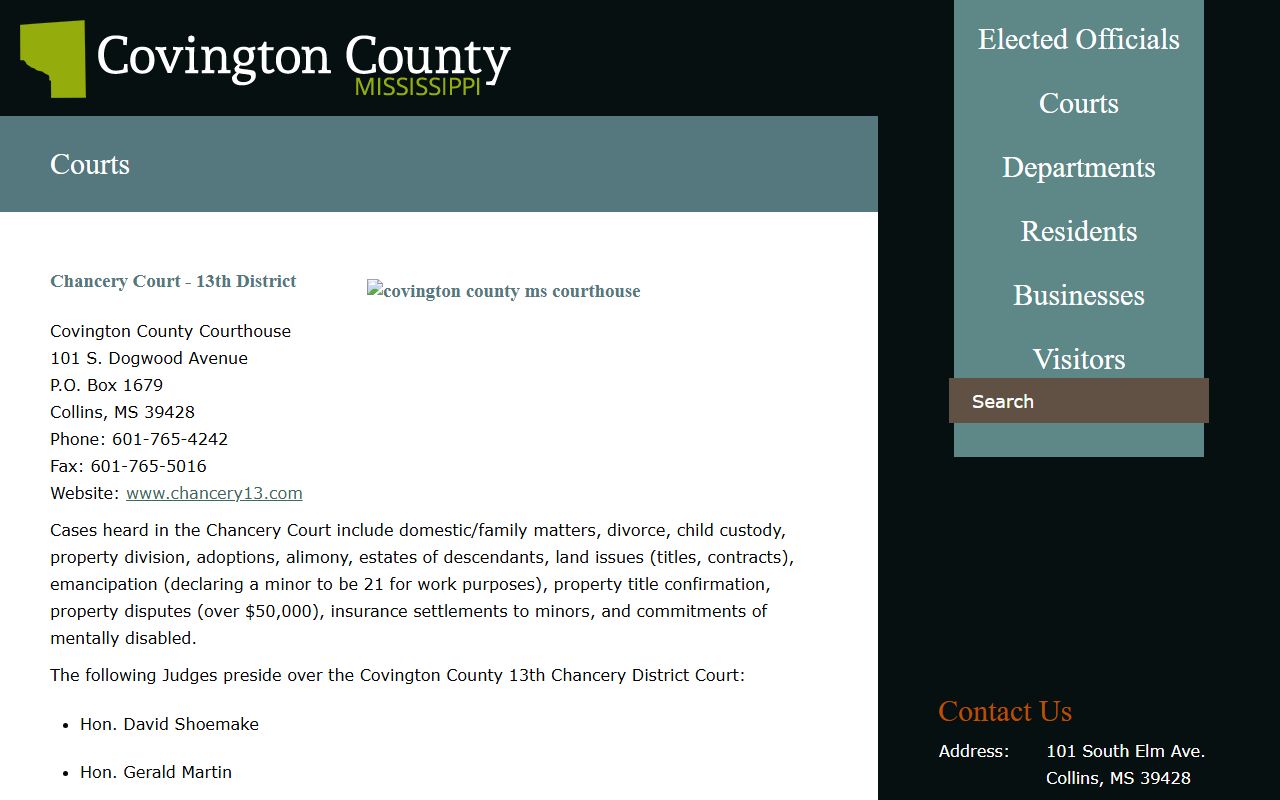
The court contact list is important because current jail custody and formal case records are maintained by different offices.
Find Covington Court Records
Start with enough booking information to identify the right person and approximate date. Then route the records question to the court that handles the filed matter. Circuit Court District 13 is listed at Covington County Courthouse, 101 S. Dogwood Avenue, P.O. Box 667, Collins, MS 39428, phone 601-765-6506, fax 601-765-5012, email mduckworth@covingtoncountyms.gov. Justice Court is listed at P.O. Box 665, Collins, MS 39428, phone 601-765-6581, fax 601-765-5014, with Cassity Booker as clerk and email cbooker@covingtoncountyms.gov.
- Confirm the booking date, arresting agency, and custody status with the Covington County Sheriff's Office if the case is recent.
- Use the Mississippi Electronic Courts gateway for participating court access, including Covington County Circuit Court where available.
- Ask the Circuit Clerk or Justice Court clerk for a defendant-name and date-range search if MEC access does not show the record or requires login.
- Read the filed charge list, bond order, warrant return, hearing settings, and disposition separately from the original jail booking label.
MEC is a gateway rather than a simple free public roster. Access may depend on court selection, account status, payment rules, and document type. Public courthouse access through the clerk remains the fallback for older files, restricted remote documents, or records not available through the portal.
MEC Court Search Fields
The public MEC landing page did not expose a full case-search form in the captured research output. The research supports a gateway table rather than invented fields.
| Field Label | Type | Required | Options / Format Notes |
|---|---|---|---|
| Search for a Court and Login | Link or gateway | n/a | Select Covington County Circuit Court or another participating court. |
| Defendant name / case number | Portal search fields | Varies | Available after selecting or logging into the court system. Verify in live MEC. |
| Clerk in-person request | n/a | n/a | Provide name, case number if known, date range, and criminal or civil division. |
Charging Documents After Arrest
Booking charges are preliminary custody labels. The prosecutor may review law-enforcement reports and decide what charges to pursue in court. In the 13th Circuit Court District, the district attorney identified in current research is Christopher D. Hennis, also listed as Chris Hennis, with District 13 covering Covington, Jasper, Simpson, and Smith counties. His listed 2025 map phone is 601-847-1342.
| Document | Who Usually Initiates It | Common Use | What to Check |
|---|---|---|---|
| Complaint | Officer or prosecutor | Initial accusation or lower-court criminal matter | Charge wording, court, defendant name, date, and bond setting. |
| Information | Prosecutor | Formal charge filing where allowed | Whether the defendant waived indictment or the case posture supports filing by information. |
| Indictment | Grand jury | Felony prosecution after grand-jury action | Count numbers, statutory labels, arraignment status, and later amendments. |
A filed charge may be amended, reduced, dismissed, or replaced. That is why court records after a jail arrest should be checked by case number and date instead of relying on a single arrest summary.
Court Record Charge Status
Charge status describes where a filed accusation stands in court. It does not always match the language used at booking. A jail entry may show the cause of imprisonment or warrant basis, while the court file shows prosecutor filings, judge orders, and case outcomes.
| Status | What It Means | Why It Matters |
|---|---|---|
| Pending | The charge has not reached final disposition. | Future court dates, bond conditions, or warrant issues may still control custody. |
| Amended | The filed charge or count language changed. | The active charge may differ from the booking label. |
| Reduced | The prosecution or court moved the accusation to a lesser offense. | Case level, bond, plea posture, and sentencing exposure can change. |
| Dismissed | The court record no longer carries that charge as an active pending matter. | Dismissal is not the same as expunction; public records may still exist until a court orders otherwise. |
| Nolle prosequi | The prosecutor declines to pursue the charge further. | The case record may remain visible even though prosecution stopped. |
Bond Records After Arrest
No Covington County jail bond page or official fee table was found. Bond should be treated as a sheriff and court workflow, not a guaranteed online payment workflow. Call the sheriff at 601-765-8281 to ask whether bond has been set, whether a hold exists, and where bond must be posted. If staff say a judge, Justice Court, Circuit Court, or municipal court must act first, contact that court before sending money.
| Bond or Hold Type | How It Works |
|---|---|
| Cash bond | Money paid directly as security for appearance. Confirm exact recipient and accepted payment methods with the jail or court. |
| Surety bond | A licensed bail bonding company posts surety under state rules, and the defendant or family pays the bondsman's fee. |
| Property bond | Real property may be pledged if accepted by the court. It is not available for every case. |
| Personal recognizance / own recognizance | Release without upfront bond money, based on a promise to appear and any court conditions. |
| No-bond hold | A court order or legal bar prevents release unless a judge changes the hold. |
| Other-agency hold | Another county, MDOC, ICE, probation, parole, or federal authority may block release even if local bond is posted. |
Warrants and Court Records
No current official Covington County sheriff warrant-search page was located on the active county website. The older 2020 report about a prior sheriff site with Most Wanted content should not be treated as a live warrant list. For warrant questions, call the sheriff for sheriff warrant or custody issues, Justice Court for lower-court and traffic matters, Circuit Clerk or Circuit Court for felony case status, and municipal police or court for city matters when Collins or Mount Olive is involved.
An arrest warrant authorizes arrest on a criminal accusation. A bench warrant is issued by a court for failure to appear or comply. A search warrant authorizes search of property and is not an inmate lookup. A fugitive warrant or hold may involve another county or state. A warrant becomes part of the jail-to-court record when the person is arrested, surrendered, booked, or brought before the issuing court.
Charges Versus Convictions
A charge is an accusation or filed count. A conviction requires a guilty plea, verdict, or other final adjudication. Arrest and booking do not prove guilt, and a court record can show a pending case, dismissed charge, amended charge, or non-conviction disposition.
| Charge | Conviction | |
|---|---|---|
| Stage | Accusation, complaint, information, indictment, or amended count | Final result after plea, verdict, or qualifying adjudication |
| Meaning | The person has been accused in court | The person has been found or has admitted guilt under court process |
| Custody Impact | May affect bond, holds, hearings, and conditions | May affect sentence, probation, MDOC transfer, fines, or later release |
| Public Record | Often public unless restricted | Often public unless sealed, expunged, juvenile, or otherwise restricted |
Sealed vs. Expunged Arrest and Court Records
Mississippi Code Section 99-19-71 allows petitions for expunction in listed misdemeanor, felony, and non-conviction circumstances, including certain cases where an arrest was made and charges were dismissed, dropped, or the person was found not guilty. Eligibility depends on the statute, disposition, prior history, waiting period, and the exact court order. A clerk can explain filing access, but legal eligibility may require an attorney.
| Sealed | Expunged | |
|---|---|---|
| Basic Effect | Public access is limited by court rule or order. | An eligible arrest or case record is cleared from public access under an expunction order. |
| Record Location | The record may still exist with access restrictions. | Agencies may be ordered to remove or treat the record according to the expunction order. |
| Who Decides | Court, statute, or rule controlling restricted access. | Court order under Mississippi expunction law. |
| Eligibility | Depends on juvenile, sealed, confidential, or restricted-record rules. | Depends on Section 99-19-71 and the case outcome. |
Restricted Covington Court Records
The Mississippi Public Records Act generally supports public access unless a specific exemption applies, but not every arrest or court detail is open. Juvenile matters, sealed records, expunged records, medical information, victim-sensitive records, active-investigation material, and some confidential court information may be withheld or redacted. Youth Court is routed separately, and juvenile records require special caution.
Important: Public court and jail records are not consumer reports and should not be used for employment, housing, credit, insurance, or other FCRA-covered decisions.